Showing posts with label found. Show all posts

Thursday, June 25, 2009

Ian Pedigo

Skies, 2008, wood, magazine clippings, 13" x 15"

Expansion into Undeveloped Area, 2006, Installation view, CRG Gallery


Surroundings are Left Open, 2008, linen, wool, cotton, twine, tape, 42 1/2" x 63 x 8 1/2"


The Blank Volume, 2005


Normal, 2008, wood, table fragment, lighting gel, tape, magazine clippings, paint, carpet, 44" x 50" x 21"

See Ian Pedigo's website here and more info at 65 Grand and Klaus Von Nichtssagend Gallery. Ian will be in my upcoming show called Sick Shape, which will be on July 8 in Tribeca. More on that show soon.

Monday, January 26, 2009

Harry Shearer

After a seemingly endless election period, Harry Shearer’s The Silent Echo Chamber, now at the Aldrich Contemporary Art Museum, feels like the appropriate palette cleanser. While Shearer is mostly known as the voice of many Simpsons characters and for his various collaborations with Christopher Guest, it is less known that he has been exhibiting these videos of "found" live feeds since 1992. It's surprising how enthralling and fun it is watching television screens of public figures sitting, doing nothing while waiting to go on air.

The Silent Echo Chamber at the Aldrich closes on Feb 8. See my interview with Shearer below:

Jon Lutz: Your various projects really seem to compliment each other and bring something different to the table. The same could be said for The Silent Echo Chamber. Can you talk about the impetus to create this work? How long have you been making videos?

Harry Shearer: I had started collecting these images when I realized that we were in the first generation of humans where so much ordinary behavior of so many well-known people was being videographed, and that somebody should be collecting it, after which I nominated myself. So, at some point, it seemed interesting to assembled the images for public view, and the art world seemed the most congenial place to do it. I started with a show called Telesthesia, a word I'd like to think I made up, at the Fullerton Museum in Orange County, CA, in, I think, 1989. Then came Barney's windows in NYC in 1992 for the figures involved in the Democratic Convention in the city, then The Wall of Silence at MOCA's Santa Monica storefront, commemorating the OJ trial circus, and then a long pause before the Conner Contemporary Art gallery in D.C. invited me in 2004 to do what became Face Time, the immediate predecessor of this show.

JL: Do you see yourself as a “video artist?”

HS: I see myself as a guy who puts these shows together. The term "video artist" is relevant only in the sense that gives people a recognizable category into which to insert this stuff.


JL: Your long running radio show, Le Show, features your recap of the lesser-known, but significant news stories of the week. You approach the details of these stories with a dry mix of sarcasm, humor, and critique. With The Silent Echo Chamber, it appears that you have taken a more objective or contemplative approach. The biting wit is replaced with a powerful ambiguity that emerges while watching figures like Karl Rove stare blankly, James Carville fidget, or Joe Biden eat a sandwich. Is there any kind of critique here of these individual personalities or is it solely up to the viewer to come to their own conclusion?

HS: That's one reason I enjoy doing this in an art context: much more conducive to ambiguity, multiple meanings, or total lack of meaning, than the comedy/satire world, where you really care whether the audience "gets the point." There's much less critique intended here, although some may occur to some viewers. But I think, in terms of what these shows mean to me, they're much more about the contrast between TV as we know it-basically, to a large extent, radio with pictures--and the possibilities of a truly visual medium.


JL: Most of the figures are politically involved, but then you throw in people like Dr. Phil. Are your choices of subject matter colored by any personal experiences with these people or comments upon the entertainment/news business in general?

HS: Choices constrained by two factors: the ubiquity of these people, and my ability to access images of them.

JL: In one case, Ben Stein and Henry Kissinger are shown, at different times, on the same screen. Given that they bear some resemblance to each other, there is some evidence that you have done some subtle constructing and arranging for humorous effect. Is this deliberate or merely coincidental?

HS: I'm very scrupulous--or obsessive--about not editing or altering the videos. It's too easy, and then it's about me. Kissinger and Stein showed up on the same screen because neither of them is in the immediate current spotlight, a la the other folks, yet they both amuse me. And, of course, that's the Jewish screen.

JL: You have also appeared on cable news shows many times. Is any part of these about your experience of waiting to go on air? Is there an inside joke here or something going on that someone not familiar with television production might not know about these clips?

HS: No, as a matter of fact, there's no joke. Well, if there is a joke, I guess it's that never before in human history has so much valuable time been spent by so many "important" people sitting around doing nothing. That may be a distinctive mark of our era. Or of our (former) prosperity.

Tuesday, January 20, 2009

Ned Colclough

Tug of Love (detail); Read Your Mind, 18" x 24"; Florida Room (detail)


Souvenir
, 22" x 28"; All the Bass, 18" x 24"


Florida Room; Souvenir, 22" x 28"; Tug of Love; Read Your Mind, 2007, 18" x 24"

Pacific, 19" x 23"


Theme from Planet
s and detail

LinkLinkAnything at all

When I first got a peek at Ned Colclough’s studio a couple of years back, there were a few paintings on the wall, pinned up photos, and various parts that would become these constructions. I recently had a chance to stop by again and the room is now filled with finished pieces. Maybe it’s because there’s no space for more, but they seem to represent his first major body of work. I'm really into the the sculptures because they are deliberately precarious and oddly rythmic. They pivot, lean, brace, and balance with nothing but friction and gravity keeping them together. Keep an eye out for his work…

Monday, January 5, 2009

Carrie Pollack

Abbreviated Natural Experience, 2004, oil on canvas, 18" x 18"

Just a little while back, I posted a few works by Carrie Pollack from Call & Response, which featured some other artists who have appeared here. I've since gotten to see more of her works and had the chance to do an interview with her. See her website here and the interview below. Also make sure to check out her new works in Perception as Object, which opens this Thursday, the 8th at Monya Rowe Gallery.

JL: The most impressive aspect of your work is its understated quality. They are often simple, precise, with minimal color. There seems to be a singular idea explored and they rarely have an all-over or painterly quality. If just hearing this description, one might think the works are literal or obvious, but they aren’t. Is this something that emerges with deliberation or is it more of an intuitive response to a source?

CP: I think (and hope) it is a bit of both. My goal is to make a painting with as little as possible, almost stopping short to keep it open. I want them to be quiet, slow and a little unclear. I think when this happens it becomes more of a conversation then a statement, maybe somewhere in-between deliberation and intuition. I react to specific things in the world. These things have similar qualities so the choice of source is deliberate. Once I have this catalogue of images I know I want to work with I just sit and look at them for weeks. Through the looking at these images I begin to see other things at play, I think I am intuitively responding and arranging images at that point.

JL: What is you’re impression of these 2004 works, looking back at them now?

CP: They seem far away. I think they contain the same thinking but the new works are made from looking at my own photos and the older work was made by using found images. I have more of a personal relationship with the source I use now and that seems important at the moment. I think I was really trying to make a good painting then and now I am more interested in making a painting that might be a good painting.

Cloud, 2008, oil and pencil on canvas, 16" x 20"

JL: Since the two earlier works, you have developed a kind of “frame” around your images where parts of the canvas are left blank. What purpose do you see this serving, if any?

CP: My work always seemed to be like a small snapshot of something larger, or a close up of something that extends outside of the painting. With the newer paintings I wanted to play with that idea of the edge, or alluding to something happening that you couldn’t see.

JL: What happened since 2004 that allowed that frame to emerge?

CP: When I saw the first prints there were all of these smaller images on a large roll of canvas. When I stretched them and they never quite fit or stayed straight, I remember thinking that I wanted to play with that. I am also still working from source material but now it is mostly my own photographs that I take throughout the day. When I take a picture it becomes framed by the camera and a lot of the time I am taking fast photos so the edge happens on its own.

Metaphor, 2004, oil on linen, 18" x 18"


Foil, 2008, digital print and pencil on canvas, 18" x 24"

JL: Speaking of sources, I really like how you have a source page on your website. It’s cool because it looks like you often take directly from them as opposed to picking parts of them. Is this really the case?

CP: I decided to put that page on my website because people were curious about where the work was coming from. I thought that if I revealed those things people would start to see these things around them and then they wouldn’t ask where the work was coming from. They would see that it was part of a language that comes from the world. This was also a big reason to use the photos in the work itself and not just make paintings from images that no one would see. I wanted to bring the source into the work directly.

JL: How has this changed over the years?

CP: I used to just collect source from anywhere but now I have to take a picture of it. I like to have the photo and not a clipping of paper. I think it reduces the sources to all the same thing. They become a part of this big catalogue. I love Gerhard Richter’s ATLAS.


JL: What role, if any, do the various non-studio activities like studio visits, writing artists statements, teaching have in what you make?

CP: I am currently teaching painting and drawing at the U of Tennessee in Knoxville. The students have amazing thoughts and ideas and are always saying things that I have to think about. Having this time to work out ideas with other people in the studio has always helped me. The exchanges that take place with students or artist friends are so important. Making work is a way of communicating so being able to do this in any way helps to think through ideas. I love going to other peoples studios. You can tell a lot from how people set up their spaces, what they look at etc. I am also a big note taker. I am constantly writing down things I hear or read and this also help me figure things out.

Tuesday, November 25, 2008

Mike Hein

I first saw Mike Hein's work a little while back when looking at artists for The Longest Day. I'm really into what he's doing now with molded plastic, making random associations between realism and abstraction. Check out some of these nice older works to see how he got there. He currently has a work in The Object Direct at Heskin Contemporary, curated by Matthew Fisher, which closes January 3. Also see his new website here and the interview below:


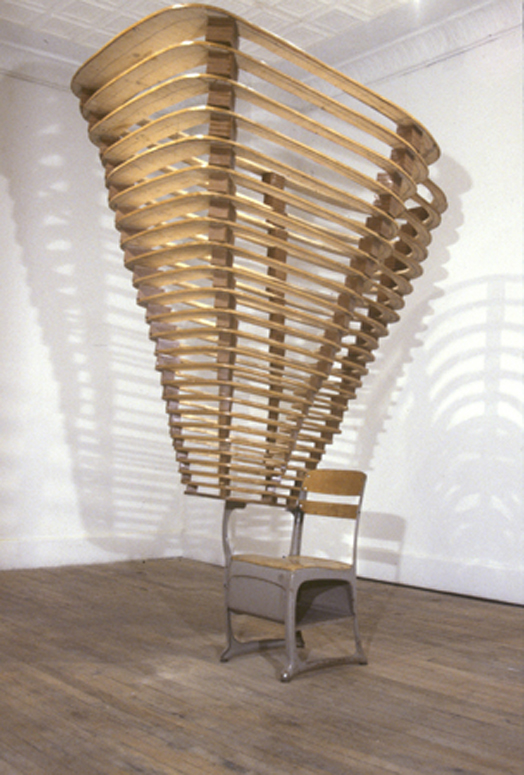
Demon Child Desk, 2002, school desk, laminate, mdf, 100" x 92" x 43"
JL: Throughout your progression, there are almost no examples where you have simply replicated/copied something. You made a move from assembling found objects in your early works (Jag in the Cemetery and Demon Child ) and to altered constructions (Slim Door), but they have never been straight-forward. Can you describe your initial approach to materials and how it has evolved?

MH: I never really thought that I was assembling found objects. I had thought of an object or material as a catalyst. Material and found objects seem the same to me they have the potential to do the same thing. Take for instance the desk and the Formica on the gravestone in Jag in the Cemetery. The desk sets up a context and experience shares by most people in North America of being in grade school. The Formica takes you to the kitchen of a middle class home. I think the desk was an anomaly though it still did what the other pieces did that did not have found objects.

I was very interested at the time at the relationship between the subject/form and the material it was depicted from. Attaching a precarious topographic form to a school desk and attaching Formica to a mdf form of a gravestone. Both transcend the sum of their parts. I think coincidentally these two examples entered into a supernatural realm via banal forms and materials.


Jag in the Cemetery, 2003, dimensions variable

JL: In many of your works, this approach sets up a kind of conflicts between thing easily recognized and something less palpable. Can you explain how this emerges?

MH: I find the only way work evolves is if I’m in the studio. I have to be messing around with the tools and materials. When I don’t have an idea I just go and experiment. Whether it be trying to depict something I haven’t before or creating a new texture in the plastic.

JL: How did you end up working with Plexiglas?

MH: I tired of using pre-fab materials. All of my references were seemingly tied to middle America. I wanted to move away from that and have broader, maybe more abstract concepts. Plastic is a raw material like a sheet of plywood or metal, but its properties are amazing. It is very workable with basic tools and is pre-colored. I’m also very attracted to the glossy finish. Concentrating on one material seems to expedite some facets of the decisions I have to make as well which, for now, are important.


Meteor (front view and side view), 2008, plexiglas

JL: Some of these are like visual malapropisms that have a humorous bent…why might you choose, say a banana peel to lie on top of a snow bank or taped pieces of paper to a rock?

MH: The snow bank and banana peels was something I saw four years ago on a snowy day in Nova Scotia and I liked it a lot. But it took along time before I figured out how I wanted to make it. I still think I could do it better. Actually that piece was destroyed in a shipping mishap. So I'll probably make it again. The meteor and rock with paper taped to it came about more like what I was talking about earlier: objects as a catalyst. I made the Icosahedrons and the idea came out of that.

JL: How important is humor in your work?

MH: I guess it is important. I don’t really think about them being funny and I never try to make them funny. It just seems to happen. I think over time common threads have lasted throughout everything I've made in my life. It's weird but a couple weeks ago I was thinking about how I was making work and how it probably exercises only some neural pathways in my brain. Now, those pathways must be wider or easier to travel and the result is that I am not totally in control of the choices I make in the work. Some things just happen.


detail of Sunset Village, 2008, plexiglas
Snow Bank with Banana Peels, 2008, plexiglas

JL: Can you talk about the other little touches and details...like the banana peels, the colors behind the meter, or the slime on the door...Where do these come from in the scheme of things just happening?

MH: Many of the "little touches" are a result of technique (i.e. tool marks and limitations of the material) like the roughness in the brim of Paper Witch Hat or the text and image inlays in the series of bags I did. Not that I just let them be without caring but I liked them formally, Sometimes a roughness happens in the work that I try very hard to get rid of, and bring back the slickness of the plastic.

This is a very good question because its something I struggle with. Keeping the plastic slick is sort of a limitation. I would love to add another dichotomy to the work- a nice clean surface vs. bubbly melted stringy plastic. I've tried to do it but it just looks like shit. Slowly, it’s coming into the work though. In Sunset Village, I embedded teeth marks into the crushed representation of the Styrofoam cup.


Slime Door, 2003, fiber glass, latex paint, ball point pen, mdf, 83 x 49 x 45

Thursday, November 13, 2008

Call & Response: J.D. Walsh


(Untitled) Imposing Entrance from JD Walsh on Vimeo.
2008, video projector, tripod, wood armature, 11" x 14"

The last, but not least, artist from Call & Response is J.D. Walsh. The Jaime Keiter stills are great, but the above video documentation gives a better sense of how amazing these look exhibited. Since my interview with him, these are dealing more directly with a delicate play between rhythm, video-as-painting, programming, and sensory experience. Also see his two works in this pic from the last post for a sense of scale.

Related
: his website, the new album by his band Nights, Solomon Projects, Perfect Strangers..., and The Longest Day.

Call & Response
, curated by Gianna Commito, is up now at Kent State University and closes Nov. 21. Previous posts on Call & Response: Carrie Pollack, Patrick Brennan, Suzanne Silver, Mary Lum.

Sunday, November 9, 2008

Call & Response: Suzanne Silver

Drawing a Blank, 2008, neon, 30" X 40"

Red (names), 2005-6, embossing labels, marley, metal, wood, 4" x 5.5" x 1.5"

Call & Response intends to highlight the flexibility of language and meaning in art. Of all of the artists in the show, Suzanne Silver takes perhaps the most direct angle, using the Talmud as primary source. According to the press release, Silver "models her drawings, paintings, and sculptures on the system of cross references, commentaries, embellishments, and amplifications found there."

Call & Response, curated by Gianna Commito, is up now at Kent State University and closes Nov. 21. Photos by Jaime Keiter.

Friday, November 7, 2008

Call & Response: Patrick Brennan

Untitled (debris), 2008, acrylic, oil, paper, pure pigment, fabric, and craft sticks on canvas, 72" X 48"
Untitled (fashion shirt), 2008, acrylic, oil, paper, pure pigment, fabric, and craft sticks on canvas, 72" X 48"

detail of Untitled (fashion shirt), 2008, acrylic, oil, paper, pure pigment, fabric, and craft sticks on canvas, 72" X 48"

One of my faves, Patrick Brennan, has two large works in Call & Response. He seems to be experimenting more with the limits of the black as outlining/covering element and expanding his manipulations of surface and material. Check out his past posts where we talked about these black works and showed some of his older works. Also see his website here.

Update: Patrick will be in The Object Direct, curated by Matthew Fisher at Heskin Contemporary, opening Nov. 20.

Call & Response, curated by Gianna Commito, is up now at Kent State University and closes Nov. 21. Photos by Jaime Keiter.

Wednesday, November 5, 2008

Call & Response: Carrie Pollack

Mirror, 2008, oil on canvas, 12" x 16", Diamonds, 2008, oil on canvas, 16 x 20

Fracture, 2008, digital print on canvas, 18" x 24", Betwixt, 2008, oil on canvas, 16" x 20"

Over the next week, I'm going to post a few images from each of the artist's in Call & Response, an exhibition curated by Gianna Commito at Kent State University. Unfortunately, I won't get a chance to see the show, but Jaime Keiter, of The Light Archive, took some pics. In case you're in or around Ohio, the show closes Nov. 21.

I started with Carrie Pollack because, as this is the first time I'm seeing her work, I'm really curious about what's she's doing. The press release says that she "photographs quiet, often 'accidental' occurrences in her Brooklyn neighborhood." These photos are then are printed or reproduced in paint on canvas. You can see more of her works here.

Wednesday, October 22, 2008

Martin Bromirski

Humberto, God of Knowledge and Rapture, 1991


Two Potatoes Two Worlds, 1989
Celestial Potato, 1989

from Circus on Mars, 2008

Texas Potatoes, 1989

Untitled, 2006

Martin Bromirski's show, Circus on Mars is up now at John Davis Gallery in Hudson, NY. The works are hung in an old carriage house and it closes on Nov. 2. See a discussion with Martin about the show and his work in the comments...

Monday, October 20, 2008

Jonathan Horowitz


Rainbow American Flag on Pink Field of Jasper in the Style of Artist's Boyfriend, 2007, acrylic and glitter on linen, 66” x 49”


Three Rainbow American Flags for Jasper in the Style of the Artist's Boyfriend, 2005, glitter and oil on linen, 31” x 45¾” x 5”
images courtesy the artist and Gavin Brown’s enterprise, New York

Because Modern Art Notes is currently doing a series on the flag in contemporary art, I thought I would post what I think are two of the great examples by Jonathan Horowitz. I also posted on the BuzzFeed page specific to this project, saying "Jonathan Horowitz's take on the Johns flag turns a sign-of-a-sign into a sign of the times. Looking like a glittered birthday cake or a flea market t-shirt, his America is alive with ambivalence. It's garish but personal, tasteless, but honest."

His current show, Obama '08 is up now at Gavin Brown's enterprise, complete with an over-sized Hillary Clinton figurine, celebratory balloons, and an homage to the Hall of Presidents.

Wednesday, October 8, 2008

Jaime Gecker


I will do a typically Old Gold post and interview soon with Jaime Gecker. In the meantime, check out these fresh new works and her new website for many more. Also see her sculpture from The Longest Day and work in Perfect Strangers.


Renoir Times Two, 2008, ink jet photo,collage and spray paint on paper
12 ¼” x 8 7/8”

Geode, 2007, ink jet photo,collage and spray paint on paper, 4” x 6”
3 Steps, 2007, photo transfer and latex paint on canvas, 10" x 12"
Generation, 2007, polaroid film and collage, 4” x 4”
Ernestine, 2007, polaroid film and collage, 4” x 4”
Safari
, 2008, photo transfer and latex paint on canvas, 12” x 16”

Saturday, October 4, 2008

Eunice Kim


Eunice Kim’s show Moon the Magic Loser, now up at Canada, might look something you've seen before, but there are many subtle surprises. On paper, you have a grouping of thrift store objects placed in a gallery where old New York Times cover the wall. Instead of being too clean or deliberate (Nick Hess at the Project), her assemblages, collages, and found objects are yellowing, dusty, dirty, and broken. Moon the Magic Loser closes on October 19. Check it out.

Also see: Rob Pruitt at Gavin Brown's Enterprise and Liz-n-Val's newspaper works.

images courtesy Canada.